How Does a Chronograph Work? A Clear Guide
A chronograph is not just a watch with extra dials. It is a timing instrument built into a watch movement, giving the wearer the ability to measure an event without stopping the main time display. From a lap around the track to a parking metre countdown, the appeal is immediate: press a pusher, start the seconds hand, and take control of the clock.
For anyone drawn to the purposeful look of a Daytona-style layout or a motorsport-inspired tachymeter bezel, understanding the mechanism changes what you see on the wrist. Those sub-dials are not decoration. They are evidence of a compact mechanical system doing serious work beneath the crystal.
How Does a Chronograph Work?
At its simplest, a chronograph works as a stopwatch that shares a movement with the watch's normal timekeeping mechanism. The standard hour, minute and running-seconds functions continue as usual, while a separate set of components can be engaged to measure elapsed time.
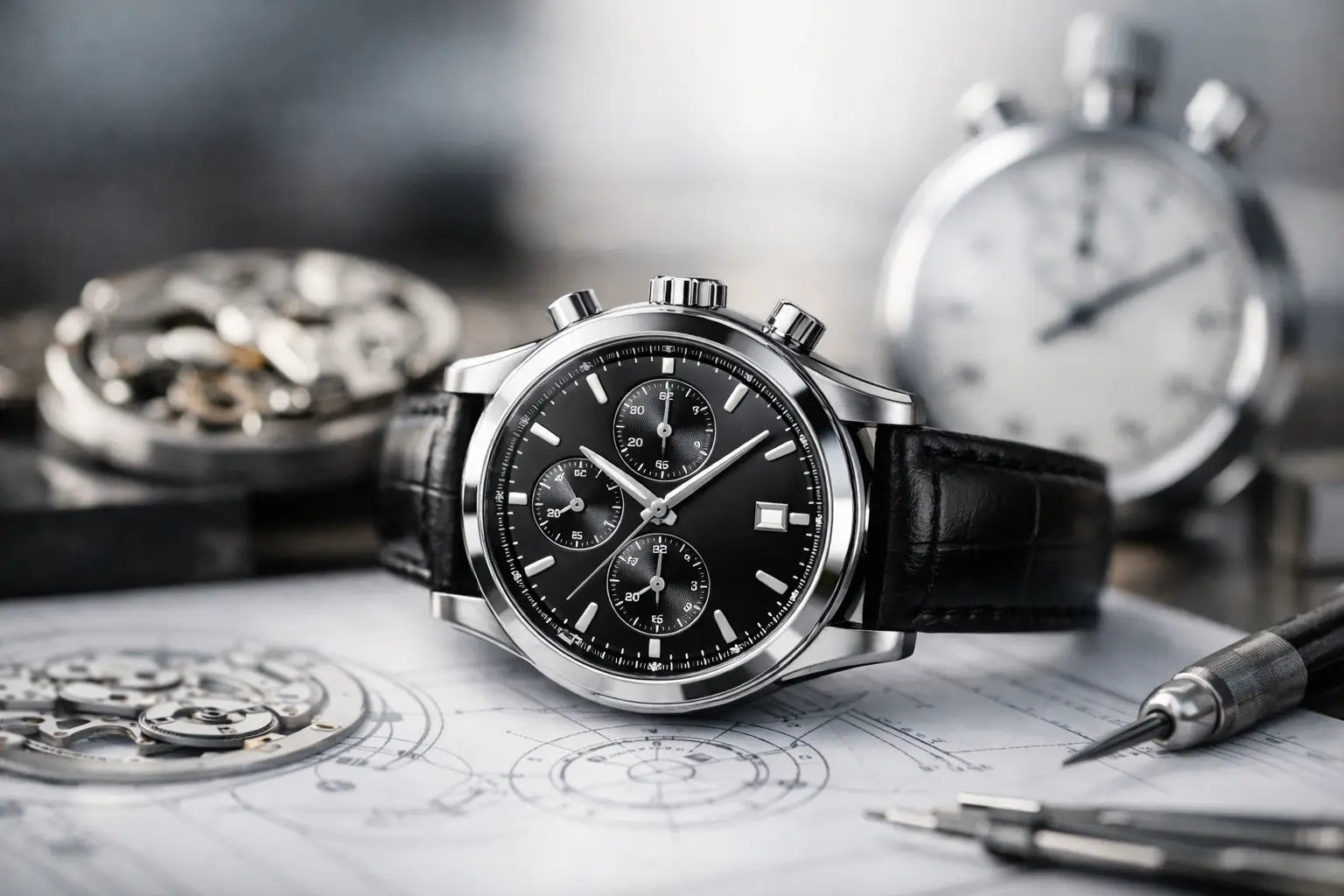
Most traditional chronographs use two pushers on the right side of the case. The upper pusher, usually at 2 o'clock, starts and stops the timing function. The lower pusher, usually at 4 o'clock, resets the chronograph hands to zero after it has been stopped. On many watches, the large central seconds hand is the chronograph seconds hand, not the ordinary seconds hand. The regular running seconds are instead shown on a smaller sub-dial.
Press start and the central hand begins sweeping around the dial. After 60 seconds, a small minute counter advances by one minute. Depending on the watch, another sub-dial may record elapsed hours. Stop the chronograph, read the result, then reset it. The principle is clean. The engineering required to make it reliable is not.
What Happens Under the Dial
A mechanical chronograph starts with the same core idea as any mechanical watch: stored energy. Winding the crown tensions a mainspring, which releases power gradually through the gear train. The escapement regulates that release, while the balance wheel oscillates at a controlled rate. This is what keeps the normal hands moving at the right speed.
The chronograph sits alongside this timekeeping system. When the start pusher is pressed, a lever system engages the chronograph mechanism with the movement's fourth wheel, the wheel that typically turns once per minute. That connection drives the central chronograph seconds hand.
The action has to be precise. If the chronograph wheel engages poorly, the seconds hand may jump, stutter or fail to align cleanly at zero. In a well-adjusted movement, the hand starts decisively and tracks smoothly, with the exact visual character depending on the movement's beat rate. A higher-beat mechanical movement tends to create a finer sweep than a lower-beat calibre, though neither is inherently better in every respect.
Once the chronograph is running, a series of wheels and cams or columns directs its energy towards the counters. A minute counter advances when the seconds hand completes a full rotation. An hour counter advances more slowly, allowing longer intervals to be measured. These counters are geared independently, which is why they can display elapsed minutes and hours while the central hand keeps counting seconds.
Column Wheel vs Cam Actuation
Two common control systems govern how a mechanical chronograph starts, stops and resets: the column wheel and the cam system.
A column wheel uses a small, castellated wheel that rotates when the pusher is pressed. Its raised columns and gaps guide the levers through each action. It is admired for its intricate construction and often produces a crisp, deliberate pusher feel. It is also more demanding to manufacture and adjust.
A cam-actuated chronograph uses shaped levers and a pivoting cam instead. It is generally more straightforward to produce and can be exceptionally dependable. The pusher action may feel firmer or more direct. Neither layout automatically guarantees a superior watch. Execution matters more than prestige language stamped on a specification sheet.
The Reset Function
Resetting is one of the most satisfying moments in chronograph ownership. After the timer is stopped, pressing the lower pusher activates reset hammers. These hammers strike heart-shaped cams attached to the chronograph hands and counters.
The clever part is the heart cam's shape. Regardless of where a hand has stopped, the hammer drives the cam back to its single zero position. This lets the central seconds, minute counter and hour counter return together. It looks instant, but it is a controlled mechanical correction carried out across several components at once.
Do not reset a traditional chronograph while it is still running unless the watch is specifically designed as a flyback. Doing so can force parts together at the wrong moment and cause damage. The normal sequence is start, stop, reset.
What the Sub-Dials Actually Do
Chronograph layouts vary, but the three-register design is the one most people recognise. It often includes a running-seconds display, a 30-minute counter and a 12-hour counter. The exact positions differ by model and movement architecture, so read the dial rather than assuming every sub-dial has the same role.
A two-register chronograph may omit the hour totaliser, while a compact bicompax layout often places its counters at 3 and 9 o'clock. Some watches use a 60-minute totaliser rather than 30 minutes. Others combine functions through unusual hand arrangements. That is part of the appeal: a chronograph dial can be highly technical without becoming unreadable, provided the design has discipline.
The date can complicate the layout further. So can a 24-hour indicator, which is frequently mistaken for an elapsed-time counter. A 24-hour hand usually tracks the current time in a second format. It does not move when you press the chronograph pushers.
The Tachymeter Is a Scale, Not the Stopwatch
A tachymeter scale is commonly printed around the bezel or outer edge of a chronograph dial. It calculates average speed over a known distance, usually one mile or one kilometre. The calculation assumes the distance is fixed and the event takes less than 60 seconds.
To use it, start the chronograph at the beginning of a measured mile or kilometre. Stop it at the end. If the central seconds hand stops at 30 seconds, the tachymeter indicates 120, meaning an average speed of 120 units per hour. If you measured one mile, that means 120 mph. If you measured one kilometre, it means 120 km/h.
It can also be used for production rate. Time how long it takes to produce one item, then read the scale to estimate how many could be produced in an hour. Useful in theory, less vital when timing your espresso queue. But the tachymeter remains one of watchmaking's most recognisable signals of race-bred design and functional intent.
Mechanical vs Quartz Chronographs
The visual layout may be similar, but the timing mechanism changes significantly between mechanical and quartz chronographs.
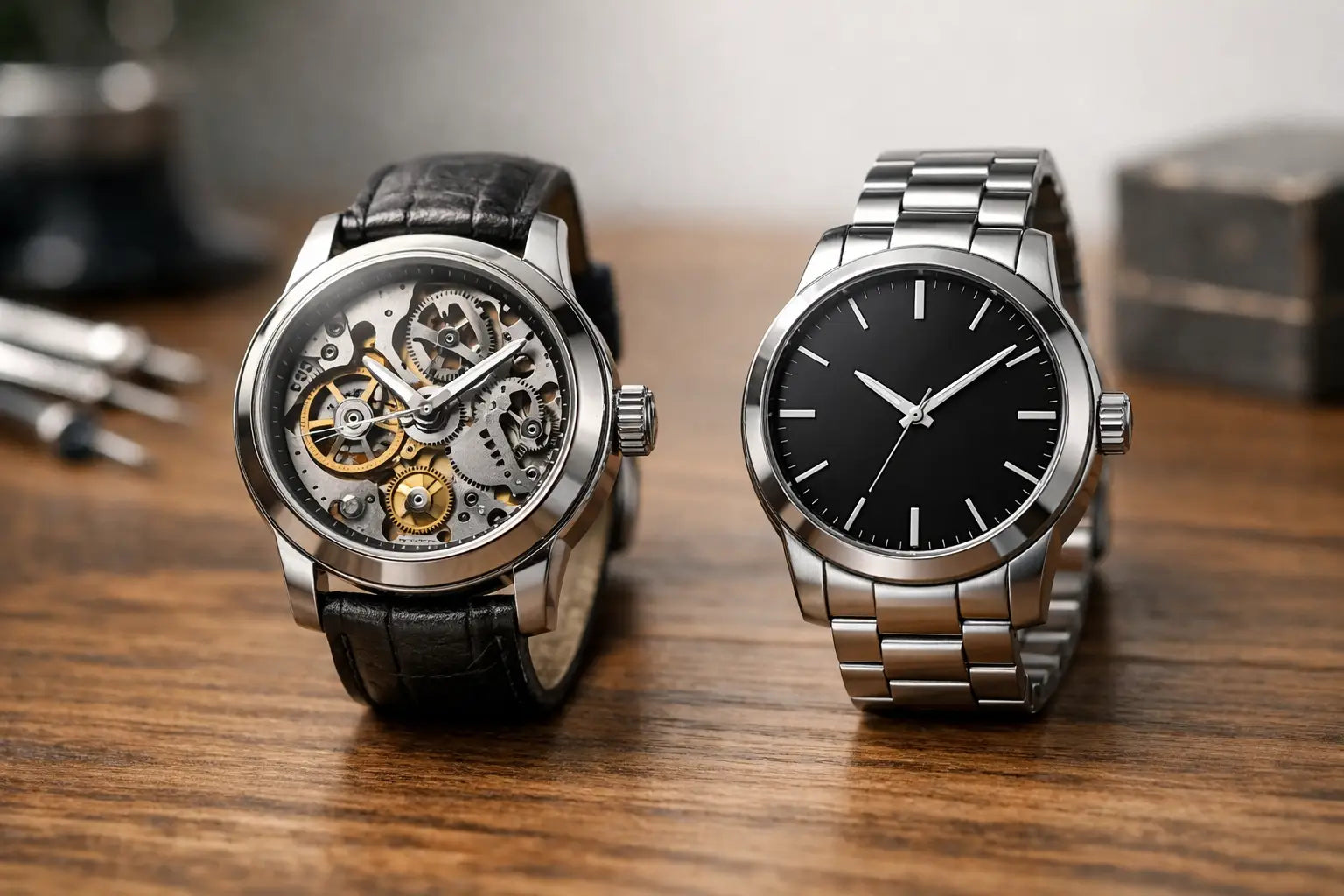
A mechanical chronograph is powered by springs, gears, levers and carefully controlled friction. Its attraction is physical: the resistance of the pushers, the sweep of the hand and the knowledge that a dense system of moving parts is operating under the dial. It requires regular servicing, and its timing precision can be affected by magnetism, shock, wear and adjustment.
A quartz chronograph uses a battery and a quartz crystal to regulate time electronically. It is usually more accurate for everyday timing, often more affordable to maintain and may offer a central seconds hand that moves in one-second steps or in finer fractional increments. Some quartz chronographs can measure tenths of a second, while mechanical versions typically prioritise traditional construction over absolute stopwatch accuracy.
The trade-off is straightforward. Quartz gives practical accuracy and low-maintenance convenience. Mechanical gives character, tactile engagement and movement architecture worth examining. Choose according to what you want from the watch, not the claims printed beside it.
Special Chronograph Functions
Not every chronograph follows the standard start-stop-reset sequence. A flyback chronograph allows the wearer to reset and restart the timer with a single press while it is running. It was developed for situations where consecutive timing intervals matter, such as aviation or navigation. It is more complex than a conventional chronograph because the mechanism must safely disengage, reset and re-engage at speed.
A split-seconds chronograph, also called a rattrapante, uses two superimposed seconds hands. One can be stopped to record an intermediate time while the other continues running. Press again and the stopped hand catches up. It is a remarkable complication, but also a more expensive and delicate one to service.
There are also monopusher chronographs, controlled by one button for start, stop and reset. Their vintage-inspired symmetry is appealing, although operation is less intuitive if you are used to the standard two-pusher arrangement.
A chronograph earns its presence when the details are right: clean hand alignment, legible counters, positive pusher action and a movement matched to the purpose of the watch. Next time you press that upper pusher, watch the central hand closely. You are not merely starting a timer. You are engaging a compact machine built to make every second visible.