How Watch Water Resistance Works Under Pressure
A watch can look built for the deep - solid steel case, sapphire crystal, screw-down crown, serious weight on the wrist - and still be vulnerable if one seal has failed. That is the reality behind how watch water resistance works. It is not a permanent forcefield. It is a system of precisely fitted parts designed to keep water out under a stated level of pressure.
For a watch worn hard, water resistance is not a spec to glance at once and forget. It affects whether you can wash your hands without hesitation, take it through a downpour, swim on holiday or use its pushers around water. The rating matters, but so do the construction, the condition of the seals and how the watch is actually used.
How Watch Water Resistance Works
Water resistance comes from compression. A watch case has several potential entry points: where the crystal meets the case, around the crown stem, beneath chronograph pushers, at the caseback and sometimes around a helium valve or rotating bezel assembly. At each of these points, manufacturers use gaskets - tiny rings usually made from rubber, silicone, nylon or fluoropolymer - to create a tight barrier.
When the case is assembled correctly, the crystal, caseback, crown tube and pushers compress those gaskets. That compression prevents water from passing through gaps too small to see. The case itself may be machined from steel, titanium, gold or ceramic, but the seals do the critical work.
Pressure changes the equation. The deeper a watch goes, the greater the force pushing water against every seal. A properly engineered case directs that force in a useful way: pressure can press the crystal and caseback more tightly into their gaskets. But this only works within the watch's tested design limit. A damaged crystal, cross-threaded crown or flattened gasket gives water a route in, regardless of how impressive the case looks.
Water resistance also protects against humidity and accidental exposure, not just obvious submersion. Steam, rain, splashes and a wet sleeve can all challenge a weakened seal. Once moisture enters a mechanical movement, it can corrode steel components, contaminate oils and turn a simple service into an expensive repair.
Metres, Bar and ATM: What the Numbers Actually Mean
The figure on a dial or caseback is commonly misunderstood. A watch marked 30 metres is not an invitation to dive to 30 metres. These ratings are generally based on controlled laboratory pressure tests. They do not fully replicate swimming, jumping into water, moving your arm quickly or exposing a warm watch to cold water.
A 30 m, 3 bar or 3 ATM rating is best treated as protection against everyday contact with water: rain, hand washing and occasional splashes. Do not rely on it for swimming. A 50 m rating offers more margin, but many manufacturers still position it mainly for everyday wear rather than regular pool use.
At 100 m or 10 bar, a watch is usually suitable for swimming and surface water activities, provided the crown is secured and the watch is in sound condition. This is the sensible baseline for a daily sports watch that will see pools, sea water and unpredictable British weather.
A 200 m rating normally signals a more capable aquatic build. It is often paired with a screw-down crown, stronger gaskets and a more substantial case construction. That does not automatically make every 200 m watch a professional dive instrument, but it gives a meaningful cushion for swimming, snorkelling and active water use.
Ratings of 300 m and beyond belong to serious dive-watch territory. These watches may add features such as a unidirectional timing bezel, highly visible lume and purpose-built crown guards. Yet a high rating is not permission to neglect maintenance. A 300 m watch with aged seals is less trustworthy than a recently pressure-tested 100 m watch.
Why movement in water matters
Static pressure testing measures a watch while it is still. Real life is less polite. Swimming strokes, diving from a pool edge and jetting water from a shower can create fast, localised pressure changes around the crown and crystal. Heat introduces another variable. A watch warmed in a hot shower can cool quickly under water, causing materials to contract at different rates.
That is why showering with any watch is a poor habit. Hot water, soap and shampoo can degrade gasket lubricants and leave residue around the crown. Steam is particularly intrusive because it can reach vulnerable areas before condensing. Save the watch for the pool, not the shower.
The Crown Is the Main Weak Point
The crown is the control point for winding and setting the watch, which makes it the most common route for water ingress. On a standard push-pull crown, a gasket around the stem provides the seal. It can be effective, but it relies on the crown being fully pushed home and the gasket being healthy.
A screw-down crown adds another layer of security. It threads onto a tube attached to the case, compressing gaskets when tightened. This is why it is a familiar feature on tool watches and dive-oriented sports models. It does not make the watch invincible. It simply creates a more dependable seal when used correctly.
Never adjust the time, date or wind a watch while it is wet or underwater. Do not unscrew the crown at the poolside just because the water has stopped dripping. Dry the case first, then handle it. If the crown does not thread smoothly, stop. Forcing it risks damaging the threads or the sealing surfaces.
Chronograph pushers deserve the same caution. Unless a watch is specifically designed for underwater pusher operation, do not start, stop or reset a chronograph in water. The pushers move directly through the case wall. Pressing them can momentarily disturb the seal at exactly the point water is pressing hardest.
What Weakens Water Resistance Over Time
A water-resistance rating describes a watch when it leaves testing, not necessarily its condition three years later. Gaskets age. Lubricants dry out. A knock can slightly distort a caseback or crack a crystal at the edge. Even a crown that is opened and closed frequently will experience wear.
The main threats are straightforward:
- Impact can damage a crystal, crown tube, caseback or gasket seat without leaving obvious evidence.
- Chlorine, salt water, soap, sunscreen and sweat can leave deposits that affect seals and metal surfaces.
- Heat and rapid temperature changes make materials expand and contract, reducing the consistency of the seal.
- Opening the case for a battery change, repair or movement work requires proper resealing and pressure testing afterwards.
Pressure Testing Is the Only Real Proof
You cannot confirm water resistance by looking at a watch. The crown may feel tight. The caseback may appear perfect. Neither tells you whether the gaskets still hold pressure.
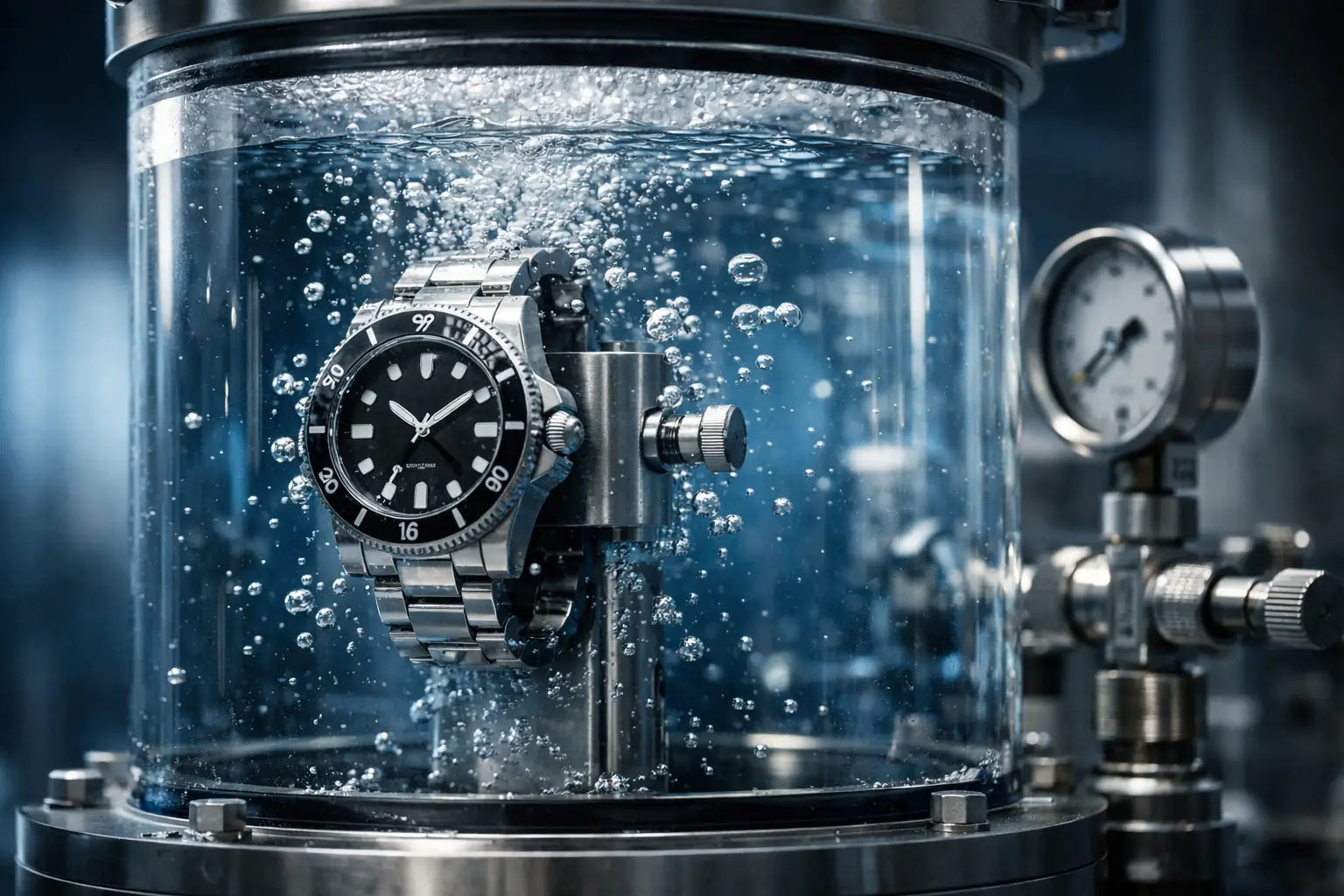
A competent watchmaker can test the case using dry pressure equipment, wet testing equipment or both. Dry testing places the watch in a pressurised chamber and measures tiny changes in case deformation. Wet testing uses air pressure before the watch is exposed to water, helping identify leaks without immediately flooding the movement. The best method depends on the watch and the available equipment.
For a watch that regularly goes in water, have its water resistance checked annually. Arrange a test after a significant knock, after the case has been opened or whenever the crown has been repaired. If the watch is only exposed to rain and hand washing, testing every one to two years is still sensible.
Condensation under the crystal is a warning, not a cosmetic issue. Even a faint mist means moisture has entered the case. Stop wearing the watch, avoid setting or winding it and get it inspected promptly. Leaving it to dry on a radiator can damage oils and accelerate corrosion inside the movement.
Choose the Rating for the Life You Actually Live
A slim dress watch with modest water resistance can be the right choice for dinners, office wear and dry-day confidence. It is not the right tool for a weekend spent swimming, sailing or chasing children through a water park. There is no status in using a watch outside the job it was built for.
For most people, 100 m is the practical sweet spot: enough capability for normal water exposure without turning the watch into a specialist dive instrument. If water is central to your routine, look beyond the number alone. A screw-down crown, clear servicing history and a recent pressure test carry real value.
Water resistance is precision maintenance, not marketing theatre. Keep the crown secured, avoid steam, rinse after salt water and test the case before trusting it on your next holiday. The strongest watch is the one whose seals are still doing their job.