How to Measure Watch Size Before You Buy
A 40 mm watch can look compact, commanding or completely wrong depending on the shape of the case, the length of its lugs and the wrist beneath it. That is why knowing how to measure watch size matters more than memorising a single number from a product page. Case diameter gets the attention, but it is only one part of the fit.
The right watch should have presence without swallowing your wrist. It should sit flat, clear the edge of your wrist bone and feel intentional when your sleeve is rolled back. Whether you prefer the compact authority of a classic dress profile or the broader stance of a chronograph or sports watch, measurement cuts through the guesswork.
How to measure watch size accurately
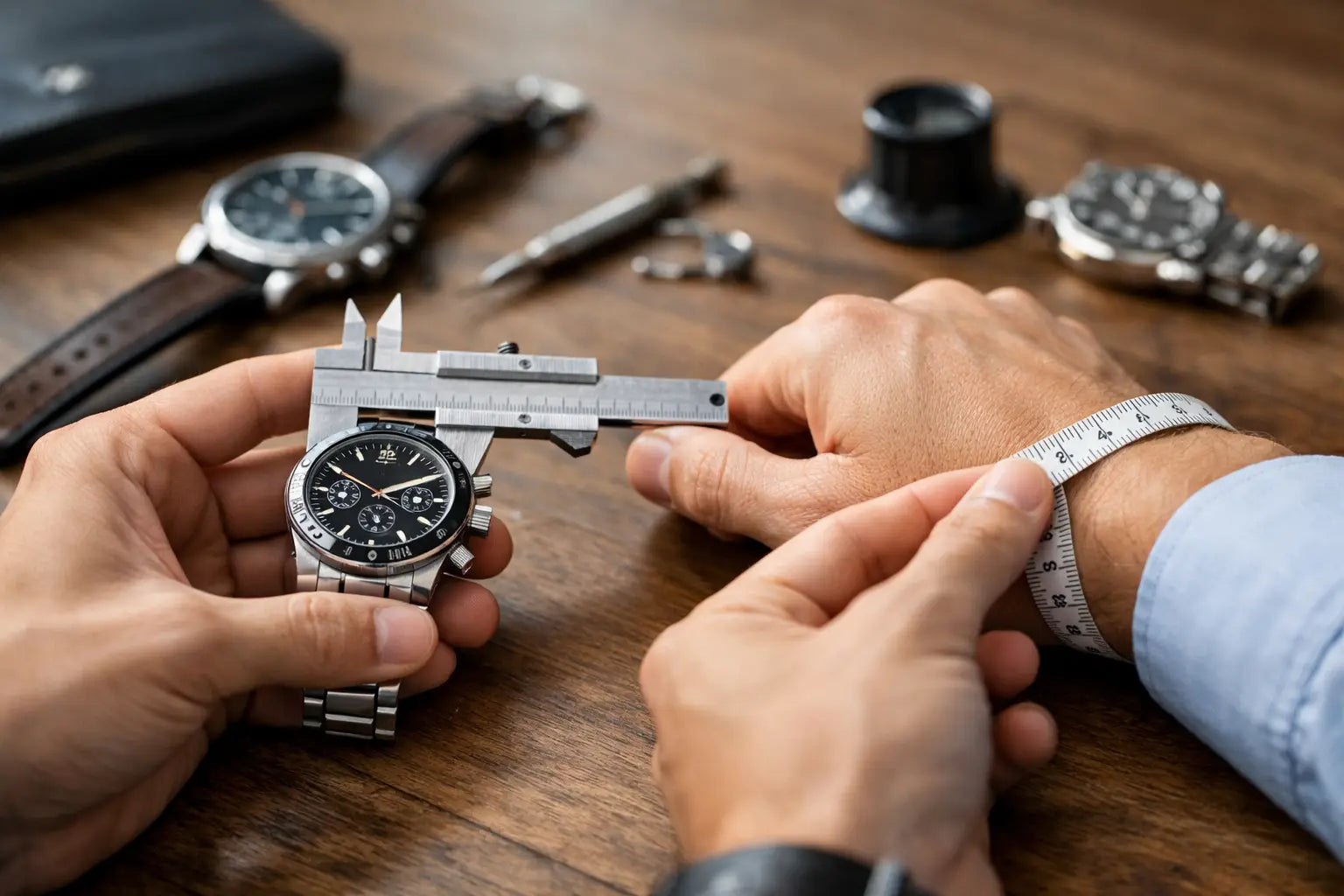
You only need a flexible tape measure, a ruler and, ideally, a watch you already know fits well. A piece of string will do if you have no tape measure. Measure in millimetres wherever possible. Watch dimensions are almost always stated in millimetres, and a difference of 2 mm is more noticeable than it sounds.
Start with your wrist circumference. Wrap the tape around the point where you normally wear a watch, usually just above the wrist bone. Keep it snug but not tight. If you are using string, mark where the ends meet, lay it flat against a ruler and record the length.
This number gives you a baseline, not a rulebook. Wrist shape matters too. A flat, broad wrist can carry a larger case than a rounded wrist with the same circumference. The underside of your wrist is also relevant: if a case is very thick, it can feel top-heavy even when its diameter looks right.
Next, understand the five measurements that dictate how a watch actually wears: case diameter, lug-to-lug length, case thickness, lug width and bracelet or strap width.
Case diameter
Case diameter is the width of the watch head, measured across the case from 3 o'clock to 9 o'clock. Do not include the crown, pushers or crown guards unless a seller specifically says the stated diameter includes them. On most watches, diameter is measured across the round case at its widest central point.
A 36 mm watch is often considered compact and versatile. A 39 mm to 40 mm watch is the modern all-rounder range. At 41 mm to 42 mm, the watch has stronger wrist presence, especially in a steel sports case. Sizes above 43 mm are deliberately assertive, but can still wear neatly if the lugs are short and curve sharply down.
Do not compare diameters in isolation. A square or octagonal case spreads its visual weight differently from a round one. A 40 mm integrated-bracelet design can look considerably larger than a 40 mm round dress watch because the case shape and bracelet create one continuous silhouette.
Lug-to-lug length
Lug-to-lug is the measurement from the tip of the top lugs to the tip of the bottom lugs. It is the most useful figure for predicting fit. The lugs are the projections that hold the strap or bracelet, and they determine how far the watch stretches across your wrist.
Measure straight from the outermost point of one lug to the outermost point of the opposite lug. If you are measuring from specifications, look for terms such as “lug to lug”, “case length” or “case height”. Not every retailer publishes it, which is frustrating because it often tells you more than diameter does.
As a practical benchmark, the lugs should not overhang the flat top of your wrist. If they extend beyond the wrist’s edges, the watch can look forced and may rock from side to side. On many average wrists, a lug-to-lug length between 46 mm and 49 mm is a confident sweet spot. Larger wrists can comfortably accommodate 50 mm or more, while smaller wrists may find 44 mm to 47 mm far more balanced.
Curved lugs reduce the effective footprint. Straight, angular lugs make a watch wear larger. This is why two 42 mm watches can feel like completely different machines on the wrist.
Case thickness
Thickness is measured from the caseback to the highest point of the crystal. Place the watch on its side and use callipers if you have them. Without callipers, use the manufacturer’s stated thickness rather than trying to estimate with a ruler.
Slim cases around 8 mm to 10 mm generally disappear under a cuff and suit formal wear. A sports watch between 11 mm and 13 mm has more physical substance without becoming cumbersome. Chronographs, divers and highly engineered automatic designs often rise to 13 mm, 14 mm or beyond.
Thickness is not automatically a problem. A substantial case can add the mechanical, weighty feel many buyers want. The trade-off is balance. A 14 mm watch with a narrow bracelet and a high caseback may sit tall, while a similarly thick watch with a broad, well-shaped bracelet can feel planted and controlled.
Lug width and strap width
Lug width is the inside distance between the lugs where the strap or bracelet attaches. Measure it with a ruler or callipers at the attachment point. Common widths are 18 mm, 20 mm, 21 mm and 22 mm.
A wider bracelet makes a case look more powerful. A 40 mm watch on a 22 mm bracelet often has a bolder stance than the same diameter on a tapered 20 mm leather strap. Conversely, a narrow strap can make a large case appear even larger because it emphasises the watch head.
For an integrated bracelet, do not rely on lug width alone. The first bracelet links can be rigid and extend the overall visual length of the watch. Treat those links as part of the case when judging whether the design will fit your wrist.
Match watch dimensions to your wrist
There is no size chart that can account for every wrist, but these ranges offer a useful starting point. If your wrist measures under 16 cm, cases around 34 mm to 38 mm and lug-to-lug lengths under 47 mm are usually the safer territory. For wrists around 16 cm to 18 cm, 38 mm to 41 mm suits most styles, provided the lugs remain controlled. Above 18 cm, 40 mm to 44 mm can look proportionate, with larger designs possible when the case shape is compact.
These are starting positions, not restrictions. A 36 mm watch can look sharp and deliberate on a large wrist, particularly when the bezel is slim and the dial is expansive. A 42 mm tool watch can work on a smaller wrist when its lugs are short, its bezel is broad and the case is shaped to follow the wrist.
The best comparison is a watch you already wear. Measure its diameter, lug-to-lug and thickness. If it feels perfect, use those figures as your benchmark. If it feels too large, identify why. Was it the overhanging lugs, the tall case or the weight concentrated at the top? That answer will steer your next choice better than chasing a generic size recommendation.
Why dial and bezel change perceived size
Visual size and physical size are not the same. A light-coloured dial, thin bezel and wide minute track make a watch appear larger because the dial occupies more of the case. A dark dial, thick bezel or sub-dials can visually tighten the design.
This matters with chronographs. Their pushers, tachymeter scales and layered dials give them a more technical, muscular presence than a simple three-hand watch of the same diameter. A 40 mm chronograph may therefore feel closer to a 41 mm or 42 mm time-only sports watch.
Bracelet finish also changes the impression. Highly polished centre links catch light and draw attention to the wrist. Brushed steel reads more restrained and tool-focused. Neither is better, but each shifts the watch’s authority in a different direction.
Check the fit before committing
When trying on a watch, look in a mirror from a normal standing distance. A close-up wrist photo can distort proportions, especially with a phone camera held near the case. Check whether the lugs sit within your wrist, whether the case lies flat and whether the bracelet drapes naturally from the first link.
Move your wrist through a normal day’s range of motion. A watch should not dig into the back of your hand when you bend your wrist, and it should not slide around when the bracelet is correctly sized. Leave enough room to fit one finger under the bracelet, then adjust based on comfort and temperature. Steel expands against the skin on warmer days.
A watch does not need to be small to be refined, and it does not need to be oversized to make a statement. Measure the case, respect the lug-to-lug, and choose the proportion that looks like it belongs on your wrist. That is where real presence starts.