
Article: How to Authenticate a Luxury Watch Properly

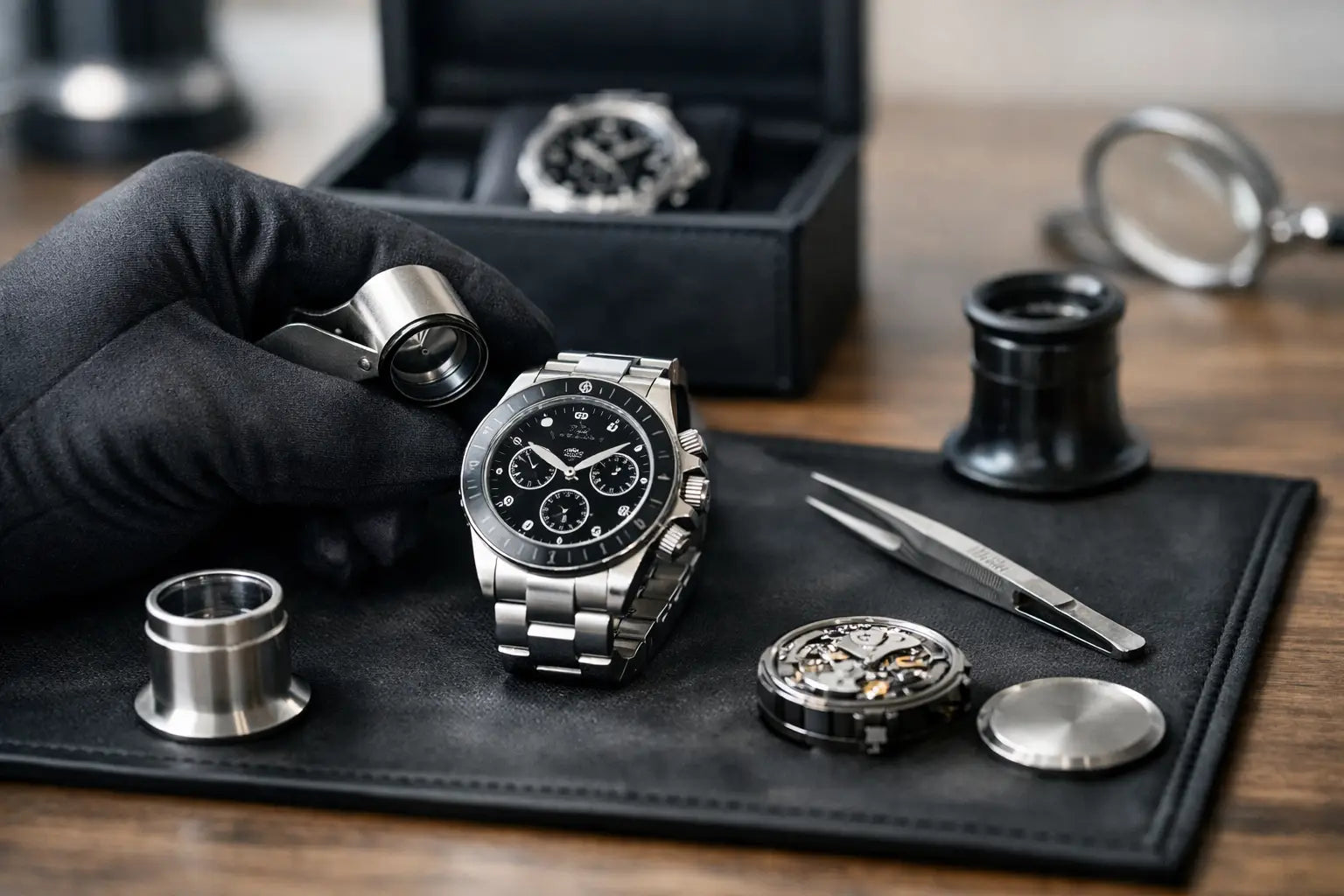
How to Authenticate a Luxury Watch Properly
A luxury watch can look convincing under shop lights and still unravel the moment it reaches a competent watchmaker's bench. If you are learning how to authenticate a luxury watch, start with one rule: never let a polished story, a familiar logo or a supposedly rare reference do the work of proof.
The strongest watches carry their quality in the details. Case geometry, dial finishing, movement behaviour and a believable ownership trail should all agree. When one element feels off, slow the transaction down. Prestige is expensive enough without paying for fiction.
How to authenticate a luxury watch before you buy
Authentication is not one test. It is a chain of checks, beginning before you handle the watch and ending with an expert inspection where the price justifies it. A seller who wants a serious buyer should expect sensible questions and provide clear answers.
Start by researching the precise reference, approximate production period, dial configuration and bracelet or strap it should have left the factory with. A Daytona, GMT-Master, Royal Oak or Big Bang can exist in several generations that appear similar at first glance but differ in proportions, clasp construction, fonts, movement layout and materials. Knowing the correct specification makes vague sales language far less persuasive.
Ask for fresh, high-resolution photographs rather than relying on catalogue images. Request straight-on dial shots, side profiles, the caseback, crown, clasp, bracelet links and any marks that identify the reference. Poor lighting can hide scratches, but it should not be allowed to hide the watch itself.
Begin with provenance, not the box
Boxes, booklets and cards can add value, but they are supporting evidence rather than proof. Packaging is easier to source, replace or pair with the wrong watch than people think. Treat a complete set as a positive sign, not a final verdict.
A credible provenance trail is more useful. That may include an original purchase receipt, documented servicing, an invoice from an established dealer, or a consistent record of previous ownership. Check that dates and model details make sense together. A watch presented as an early production example should not be accompanied by paperwork that describes a later configuration.
Serial and reference information must be consistent with the model and era, but avoid sharing full serial numbers publicly. A legitimate seller should be willing to show identifying marks privately, allowing you to verify them with an authorised service centre, respected dealer or qualified independent specialist. If the answer is pressure, excuses or a demand for immediate payment, walk away.
Read the case, dial and bracelet closely
Luxury casework is where shortcuts often become visible. The issue is rarely whether a watch feels heavy. Weight can be copied. What is harder to reproduce is the discipline of finishing: the sharpness of a bevel, the even transition between brushed and polished surfaces, the symmetry of screw heads and the way a bracelet sits against the case.
Look at the watch from different angles. On an authentic high-end piece, surfaces usually have a deliberate, controlled appearance rather than a soft or rounded look. Edges should suit the model's design language. A Royal Oak, for example, depends heavily on crisp architecture and precise alignment; an overly blunt case can destroy the intended presence even when the overall silhouette seems close.
The dial deserves the same scrutiny. Inspect printing, applied markers, date alignment and the relationship between hands and indices. Lettering should be clean and evenly placed. Applied elements should sit straight. A date should centre correctly in its window, and luminous material should appear consistently applied. Do not rely on a single macro photograph, though. Extreme close-ups can make genuine finishing look imperfect, while edited images can flatter a questionable dial.
Bracelets and clasps also tell a story. Check for smooth articulation without excessive play, even finishing across links, firm closure and correctly aligned engravings. A worn watch may show honest stretch or marks, but wear should look natural and match the condition of the case. A pristine bracelet paired with a heavily polished case deserves questions.
Test function without forcing it
Mechanical watches communicate through their operation. Wind the crown gently, set the time and test each complication according to the maker's instructions. The action should feel intentional, not gritty, loose or unpredictable. A chronograph should start, stop and reset cleanly. A GMT hand should behave as the relevant calibre requires. A date change should occur in the expected manner for that movement.
Do not confuse normal variation with fraud. Vintage watches can feel different from modern pieces, and a watch that needs a service may be genuine but poorly maintained. Equally, a smooth second hand alone proves very little. Different movements produce different visual behaviour, and many modern watches use mechanical designs that are difficult to judge from a short video.
Listen for a seller who explains condition honestly. A credible description distinguishes between authenticity, originality and service history. Those are separate questions. A genuine watch can have replacement parts. An original watch can need expensive maintenance. A recently serviced watch may still require proof of who performed the work.
The movement is the decisive evidence
For a high-value purchase, internal inspection is often the point where uncertainty ends. The movement reveals the calibre, construction quality, markings and service condition in a way exterior photographs cannot. But the case should only be opened by someone qualified, with the right tools and responsibility for water resistance afterwards.
Use an experienced independent watchmaker or recognised authentication service, particularly for models with strong resale demand. The cost of a professional inspection is modest beside the loss from buying a misrepresented watch. It can also identify issues that matter beyond authenticity, including corrosion, poor-quality replacement components, over-polishing, moisture damage and incorrect movement parts.
A proper assessment should consider whether the movement is correct for the reference, whether visible components are consistent with the stated era, and whether the watch has been altered in a way that affects value. This is especially relevant with vintage pieces, where refinished dials, replacement hands and swapped bezels can transform both collectability and price.
Know the difference between authentic, original and represented honestly
Not every watch transaction is simply genuine or fake. The reality is more demanding. A watch can be authentic yet contain later service parts. It can be assembled from genuine components from different watches. It can have an aftermarket dial, diamond setting or replacement bracelet that changes its value and should be declared plainly.
This is why language matters. Phrases such as “all original”, “factory fresh” and “investment grade” should be backed by evidence, not used as status decoration. Ask what has been replaced, refinished or repaired. Then decide whether the price reflects that history.
If you are buying a watch for its visual impact and everyday wear, some alterations may not bother you. If you are buying it as a collectible, those same alterations can be decisive. There is no shame in choosing the former. The mistake is paying collector money without collector-level verification.
A practical pre-payment checklist
Before transferring funds, make sure you can answer these questions clearly:
- Does the reference, configuration and production period match the watch being offered?
- Has the seller supplied current photographs of the actual watch from every relevant angle?
- Is there a believable ownership and service trail, beyond a box and card?
- Have identifying details been verified privately and responsibly?
- Has a qualified professional inspected the movement where the value or risk demands it?
- Does the condition match the description, including any replaced or refinished parts?
Trust the details, not the theatre
The luxury market runs on desire, scarcity and confidence. That makes it easy for a seller to create theatre around a watch: limited availability, a famous model name, an impressive box, a persuasive story about a private collection. None of it replaces evidence.
Buy the watch that holds up when the conversation becomes specific. The best feeling is not simply fastening a recognised design to your wrist. It is knowing that every detail has earned your confidence, long after the sales pitch has gone quiet.